Showing posts with label Ichthyosaurs. Show all posts

Tuesday, January 18, 2022

El Primer Gigante de los Mares: Cymbospondylus youngorum

Cuando pensamos en gigantes marinos, usualmente lo primero que nos viene a la mente son la ballenas, las cuales incluyen el animal más grande de nuestro planeta, la ballena azul (Balaenoptera musculus), que puede alcanzar hasta un largo de 29 metros (95 pies). Durante el Mesozoic, la llamada 'Era de los Dinosaurios' los océanos también tenían gigantes marinos, principalmente ictiosaurios, pliosaurios y mosasaurios. De estos tres grupos de reptiles marinos del Mesozoico, los ictiosaurios se llevan el record por alcanzar los tamaños más grandes. En mi colaboración más reciente, publicada a finales de diciembre en Science, describimos el primer ictiosaurio gigante, quien a la vez es el primer animal que se puede considerar gigante en toda la historia de vida en el planeta. La nueva especie, llamada Cymbospondylus youngorum, fue descubierta en depósitos del Triásico Medio (~242–247 millones de años) en el centro de Nevada y es parte de una fauna, conocida como Fossil Hill Fauna, que incluye siete especies adicionales de ictiosaurios y el pistorauroideo Augustasaurus hagdorni (Leidy, 1868; Merriam, 1906, 1910; Sander et al., 1997; Schmitz et al., 2004; Fröbisch et al., 2006; Fröbisch et al., 2013; Klein et al., 2020; Sander et al., 2021).
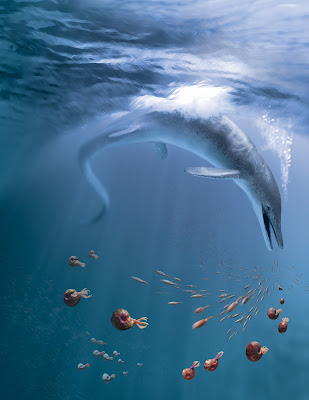
Reconstrucción de Cymbospondylus youngorum hecha por mi talentosa colega Stephanie Abramowicz (aquí pueden ver algunos de sus otros trabajo).

Con un cráneo de alrededor dos metros de largo, estimamos que el cuerpo de Cymbospondylus youngorum alcanzaba un largo de alrededor de 17 metros, lo cual es cerca al tamaño de los cachalote (Physeter macrocephalus), y unos cuantos metros más pequeño que el icitiosaurio nombrado más grande, Shonisaurus sikanniensis, que se estima medía alrededor de 21 metros (Nicholls and Manabe, 2004; Sander et al., 2021). En adición a S. sikanniensis, se han encontrado restos de otros ictiosaurios más grandes, con tamaños que se acercan a los 25 metros (Lomax et al., 2018), pero tanto estos, como S. sikanniensis, son del Triásico tardío, o sea, geocronológicamente más jóvenes que C. youngorum.
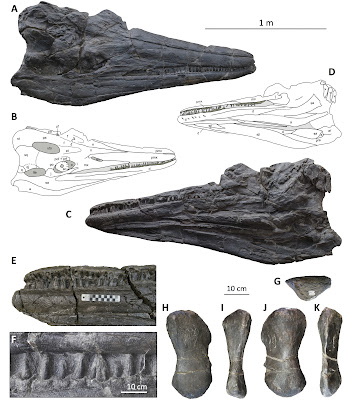
El holotipo de Cymbospondulus youngorum: vistas dorsal (A-B) y ventral (C-D) del cráneo y mandíbula; detalle de la dentadura (E-F), y húmero (H-K). El cráneo se encuentra actualmente en exhibición en el Museo de Historia Natural del Condado de Los Angeles.

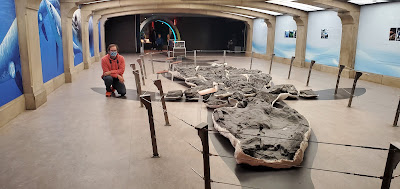
El holotipo de Shonisaurus sikanniensis, el cual tuve la oportunidad de ver en una visita reciente al Royal Tyrrell Museum en Alberta, Canada.

La Fauna de Fossil Hill representa el conjunto más diverso de ictiosarios que se conoce al momento, con especies que van desde los dos a 17 metros de largo. Esto tomó lugar alrededor de 246 millones de años atrás, apenas unos seis millones después de la extinción Permo-Triásica, (la peor de la historia y donde se extinguió alrededor de 90% de las especies en el planeta) e, interesantemente, unos tres millones de años desde que aparecen los primeros ictiosaurios . Todo esto sugiere una pronta recuperación en los océanos y que los icitiosaurios se diversificaron y alcanzaron tamaños enormes rápidamente. Con esta información en mano, decidimos explorar en mayor detalle la estructura e interacciones tróficas (quién se come a quién) en este antiguo ecosistema y tazas evolutivas en los ictiosaurios.

Además de los reptiles marinos, la Fauna de Fossil Hill incluye peces, conodontes, ammonites y posiblemente coleoideos (cefalópodos sin concha). Una de las preguntas principales que nos hicimos sobre este ecosistema antiguo fue cuan estable era este ecosistema dominado por depredadores (i.e. los ictiosaurios) aún cuando todavía no existían los productores primarios que encontramos actualmente en los océanos. Para contestar esta pregunta estimamos la masa corporal, número de individuos y requerimientos energéticos de las especies de la Fauna de Fossil Hill y usamos esa información para explorar distintos modelos computacionales de flujo de energía para determinar la estabilidad de esa red trófica. 
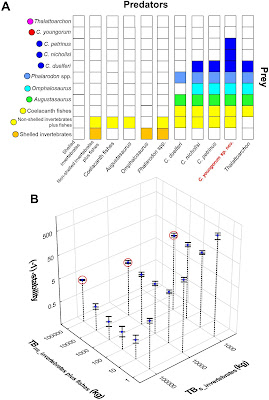
Arriba, matriz de interacciones tróficas (quién se come a quién) que utilizamos para establecer los modelos de flujo de energía entre los miembros de la Fauna de Fossil Hill.
Abajo, gráfica con los valores obtenidos con los distintos modelos de red trófica que usamos. Los distintos resultados son en base a los valores que estimamos para el total de la biomasa para peces e invertebrados con partes duras. 

Los resultados de este análisis confirmaron que el ecosistema de la Fauna de Fossil Hill si era estable, aún si solo consideramos a los amonites como los principales productores primarios y que la cadena alimenticia era más corta en comparación a las actuales. Otro aspecto interesante de esta parte de nuestro estudio es que los resultados sugieren que había comida suficiente para la presencia (hipotética) de una especie adicional de ictiosaurio gigante que consumiera alimento a granel (bulk feeding/filter feeding), como hacen los misticetos (ballenas barbadas).

El otro análisis que hicimos fue comparar las tazas de evolución de gigantismo entre ictiosaurios y cetáceos. Para esto hicimos unos análisis utilizando filogenias calibradas y estimados de tamaño de cuerpo para la mayor cantidad de especies posible de ambos grupos, que en el caso de los ictiosaurios logramos incluir 48 especies y 269 especies de cetáceos. El resultado principal de este análisis fue concluir que los ictiosaurios alcanzaron tamaños gigantes bien temprano y bien rápido en su historia evolutiva! El tiempo transcurrido desde su origen al momento que alcanzaron tamaños gigantes fue mucho más corto que en los cetáceos, que como sabemos, también alcanzaron tamaños gigantes, pero a lo largo de un periodo más largo de tiempo. En ambos grupos se detectaron aumentos en el tamaño de cuerpo en más de una ocasión, y en algunos grupos de cetáceos también observamos disminución en tamaño, particularmente en los Kogiidae (los cachalotes pigmeos y parientes extintos). 
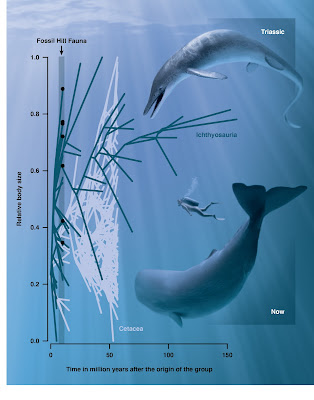
Gráfica comparando la taza de evolución de tamaño de cuerpo entre ictiosaurios (líneas azules) y cetáceos (líneas blancas). El eje 'Y' representa los valores de tamaño de cuerpo (aumentan hacia arriba), mientras que el eje 'X' es el tiempo transcurrido (en millones de años) desde el origen de los grupos. Aquí también se puede ver la similitud en tamaño entre Cymbospondylus youngorum (arriba a la derecha) y un cachalote (abajo a la derecha).

Previamente se habían publicado trabajos enfocados en la evolución de gigantismo en los misticetos (ballenas barbadas) y nuestros resultados son congruentes con los de ese estudio (Slater et al., 2017). Sin embargo, nuestro trabajo es el primero en examinar la evolución de tamaño de cuerpo que incluye todos los grupos de cetáceos, desde los más antiguos hasta los actuales. Nuestros resultados sugieren además que la evolución de gigantismo en los cetáceos está relacionado con cambios en la alimentación. En el caso de los misticetos parece relacionarse con la pérdida de dientes y alimentación a granel (bulk feeding), mientras que en los odontocetos con alimentación raptorial y búsqueda de presas a grandes profundidades.

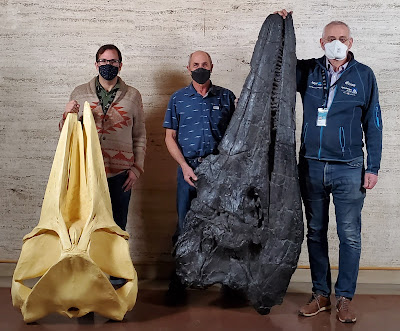
De izquierda a derecha: yo con una réplica del cráneo de un rorcual Minke (Balaenoptera acutorostrata), al centro Tom Young quien junto con su esposa son los fundadores de Great Basin Brewing Co. y a la derecha Martin Sander (University of Bonn), uno de los autores principales del trabajo, con una réplica del cráneo de Cymbospondylus youngorum. El epíteto específico "youngorum" es en honor a los Young por su apoyo a los proyecto de Martin en Nevada y a nuestro museo.

Como investigadores frecuentemente nos gusta comparar ictiosaurios con cetáceos, así que este proyecto fue muy satisfactorio ya que logramos investigar y comparar detalladamente algunos de los aspectos evolutivos que comparten ambos grupos. Para este proyecto utilizamos una combinación de métodos paleontológicos tradicionales (descripciones, medidas y observaciones, etc.) y modelos computacionales lo cual facilitó la exploración de patrones macroevolutivos usando el registro fósil de estos tetrápodos marinos. Nuestros resultados, como ya mencioné, fueron muy interesantes y no hubiese sido posible sin el diverso equipo de expertos en nuestro grupo de trabajo. Aún así, este fue un primer paso ya que queda mucho más por conocer de estos antiguos ecosistemas marinos y evolución de tamaño de cuerpo en otros grupos de vertebrados que se readaptaron a una vida en el mar.

Referencias

Fröbisch, N. B., P. M. Sander, and O. Rieppel. 2006. A new species of Cymbospondylus (Diapsida, Ichthyosauria) from the Middle Triassic of Nevada and a re-evaluation of the skull osteology of the genus. Zoological Journal of the Linnean Society 147:515–538.

Fröbisch, N. B., J. Fröbisch, P. M. Sander, L. Schmitz, and O. Rieppel. 2013. Macropredatory ichthyosaur from the Middle Triassic and the origin of modern trophic networks. Proceedings of the National Academy of Sciences 110(4):1393–1397.

Klein, N., L. Schmitz, T. Wintrich, and P. M. Sander. 2020. A new cymbospondylid ichthyosaur (Ichthyosauria) from the Middle Triassic (Anisian) of the Augusta Mountains, Nevada, USA. Journal of Systematic Palaeontology 18(14):1167–1191.

Leidy, J. 1868. Notice of some reptilian remains from Nevada. Proceedings of the Philadelphia Academy of Sciences 20:177–178.

Lomax, D. R., P. De la Salle, J. A. Massare, and R. Gallois. 2018. A giant late Triassic ichthyosaur from the UK and a reinterpretation of the Aust Cliff 'dinosaurian' bones. PLoS ONE 13(4):e0194742.

Merriam, J. C. 1906. Preliminary note on a new marine reptile from the Middle Triassic of Nevada. University of California Publications–Bulletin of the Department of Geology 5:5–79.

Merriam, J. C. 1910. The skull and dentition of a primitive ichthyosaurian from the Middle Triassic. University of California Publications–Bulletin of the Department of Geology 5:381–390.

Nicholls, E. L., and M. Manabe. 2004. Giant ichthyosaurs of the Triassic—a new species of Shonisaurus from the Pardonet Formation (Norian:late Triassic) of British Columbia. Journal of Vertebrate Paleontology 24:838–849.

Sander, P. M., O. C. Rieppel, and H. Bucher. 1997. A new pistosaurid (Reptilia:Sauropterygia) from the Middle Triassic of Nevada and its implications for the origin of the plesiosaurs. Journal of Vertebrate Paleontology 17(3):526–533.

Sander, P. M., E. M. Griebeler, N. Klein, J. Velez-Juarbe, T. Wintrich, L. J. Revell, and L. Schmitz. 2021. Early giant reveals faster evolution of large size in ichthyosaurs than in cetaceans. Science 374:eabf5787.

Schmitz, L., P. M. Sander, G. W. Storrs, and O. Rieppel. 2004. New Mixosauridae (Ichthyosauria) from the Middle Triassic of the Augusta Mountains (Nevada, USA) and their implications for mixosaur taxonomy. Palaeontographica Abt. A 270:133–162.

Slater, G. J., J. A. Goldbogen, and N. D. Pyenson. 2017. Independent evolution of baleen whale gigantism linked to Plio-Pleistocene ocean dynamics. Proceedings of the Royal Society B 284:20170546.

Friday, December 24, 2021

The First Ocean Giant

When we think of ocean giants we usually think of whales, which indeed include the largest animal known to have lived in our planet, the blue whale (Balaenoptera musculus) reaching lengths of up to 29 meters (95 feet). Things were not so different during the Mesozoic, the so-called 'Age of Dinosaurs', when the oceans had various groups of large marine tetrapods, mainly ichthyosaurs, pliosaurs and mosasaurs. Amongst these different groups of Mesozoic marine reptiles, ichthyosaurs hold the record for the largest to have swam in the Mesozoic seas. Now, in my most recent paper published yesterday in Science, we describe the first giant ichthyosaur, which also turned out to be the first giant vertebrate in Earth's history. The new species, named Cymbospondylus youngorum, was discovered in Middle Triassic (~242-247 million years ago) deposits in central Nevada and is part of an icthyosaur-rich fauna (AKA Fossil Hill Fauna) that includes at least seven other species of ichthyosaurs and the pistosauroid Augustasaurus hagdorni (Leidy, 1868; Merriam, 1906, 1910; Sander et al., 1997; Schmitz et al., 2004; Fröbisch et al., 2006; Fröbisch et al., 2013; Klein et al., 2020; Sander et al., 2021).

Life reconstruction of Cymbospondylus youngorum by my very talented colleague Stephanie Abramowicz (you should check out her other work here).

With a skull that's about two meters long, Cymbospondylus youngorum has an estimated body length of about 17 meters which is close to that of extant sperm whales (Physeter macrocephalus), and several meters smaller than the largest named ichthyosaur Shonisaurus sikanniensis which had a body length of 21 meters (Nicholls and Manabe, 2004; Sander et al 2021). There are fragmentary remains of larger ichthyosaurs, with body lengths estimates close to 25 meters (Lomax et al., 2018), but these, as well as S. sikanniensis, are from late Triassic deposits, hence geochronologically younger than C. youngorum.
The holotype of Cymbospondulus youngorum; dorsal (A-B) and ventral (C-D) views of the skull; closeup of the teeth (E-F), and humerus (H-K). The skull is currently on exhibit at the Natural History Museum of Los Angeles County.

The holotype of Shonisaurus sikanniensis, seen on a recent visit to the Royal Tyrrell Museum in Alberta, Canada.

The Fossil Hill Fauna represents the most diverse ichthyosaur assemblage known, with species ranging from 2 to 17 meters. Interestingly, this is taking place about 246 million years ago, a mere six million years after the Permo-Triassic extinction, when about 90% of organism in our planet became extinct, and 3 million years after the appearance of the first ichthyosaurs. This suggest a speedy recovery for life in the oceans, and very fast diversification and body size increase in ichthyosaurs, and made us wonder about the structure and trophic interactions in this ancient ecosystem.

Besides the marine tetrapods, the Fossil Hill Fauna includes fishes, conodonts, ammonoids and most likely coleoids (shell-less cephalopods). One of the big questions with regards to this ancient ecosystem was, how sustainable was this predator-rich environment in the absence of modern primary producers? To answer this we explored energy flux models by estimating body masses, number of individuals and energy requirements for the Fossil Hill Fauna to test food web stability. 

Top, trophic interaction matrix used for modeling energy flux amongst members of the Fossil Hill Fauna. Bottom, graphic showing values for each different food web models. Variation between the different models are based on different estimates of total biomass for "shelled invertebrates and "fish". (See our supplementary material for a more detailed explanation of the models.)

The short answer is yes, the Fossil Hill Fauna was stable, even if taking the ammonites as the sole primary producers. More interestingly, our results suggest that this fauna could still sustain additional marine tetrapods, including a hypothetical filter or bulk feeding ichthyosaur!

Our other big analysis was to compare body size evolution in ichthyosaurs and whales. For this we used time-calibrated phylogenies and body size datasets for both groups to explore body size evolution over time in these two, somewhat similar, groups of secondarily aquatic tetrapods. The big takeaway from our analysis is that ichthyosaurs got really big, really early in their evolutionary history, at a rate unmatched by cetaceans which got big at slower rates. Body size increases occurred multiple times in both groups, and we also detected body size decreases in some cetacean lineages, such as kogiids (pygmy and dwarf sperm whales and their extinct relatives). 

Comparison of body size evolution in ichthyosaurs vs cetaceans. The 'Y' axis shows relative body size (greater towards the top) and the 'X' axis is time since the origin of the different groups.

Previous work on cetacean body size evolution had focused on mysticetes (baleen whales), and our results are congruent with those studies (Slater et al., 2017). However, this was a first take on body size evolution on cetaceans as a whole, with some interesting results for odontocetes. Broadly, the evolution of large body sizes in cetaceans seems to be linked to feeding specializations, loss of teeth and bulk feeding in mysticetes and raptorial feeding and deep diving in odontocetes.

From left to right: myself with a cast of a Minke whale (Balaenoptera acutorostrata) skull, Tom Young and lead author Martin Sander (University of Bonn) with a cast of the skull of Cymbospondylus youngorum. The specific epithet of the new species is after Tom and his wife Bonda owners of Great Basin Brewing Co., and supporters of Martin's work in Nevada.

As researcher we often compare ichthyosaurs and cetaceans, so this project was extremely satisfying as we were able to really dive into some of the overlapping aspects of their evolutionary history. Our approach combined traditional paleontological methods with computational modeling bringing together a group of experts in different fields which allowed us to explore macroevolutionary patterns in these groups. While our results are very exciting, this work is a stepping stone as there is still a lot to understand about ancient marine ecosystems and body size evolution across other groups of secondarily aquatic tetrapods. 

Literature Cited

Fröbisch, N. B., P. M. Sander, and O. Rieppel. 2006. A new species of Cymbospondylus (Diapsida, Ichthyosauria) from the Middle Triassic of Nevada and a re-evaluation of the skull osteology of the genus. Zoological Journal of the Linnean Society 147:515–538.

Fröbisch, N. B., J. Fröbisch, P. M. Sander, L. Schmitz, and O. Rieppel. 2013. Macropredatory ichthyosaur from the Middle Triassic and the origin of modern trophic networks. Proceedings of the National Academy of Sciences 110(4):1393–1397.

Klein, N., L. Schmitz, T. Wintrich, and P. M. Sander. 2020. A new cymbospondylid ichthyosaur (Ichthyosauria) from the Middle Triassic (Anisian) of the Augusta Mountains, Nevada, USA. Journal of Systematic Palaeontology 18(14):1167–1191.

Leidy, J. 1868. Notice of some reptilian remains from Nevada. Proceedings of the Philadelphia Academy of Sciences 20:177–178.

Lomax, D. R., P. De la Salle, J. A. Massare, and R. Gallois. 2018. A giant late Triassic ichthyosaur from the UK and a reinterpretation of the Aust Cliff 'dinosaurian' bones. PLoS ONE 13(4):e0194742.

Merriam, J. C. 1906. Preliminary note on a new marine reptile from the Middle Triassic of Nevada. University of California Publications–Bulletin of the Department of Geology 5:5–79.

Merriam, J. C. 1910. The skull and dentition of a primitive ichthyosaurian from the Middle Triassic. University of California Publications–Bulletin of the Department of Geology 5:381–390.

Nicholls, E. L., and M. Manabe. 2004. Giant ichthyosaurs of the Triassic—a new species of Shonisaurus from the Pardonet Formation (Norian:late Triassic) of British Columbia. Journal of Vertebrate Paleontology 24:838–849.

Sander, P. M., O. C. Rieppel, and H. Bucher. 1997. A new pistosaurid (Reptilia:Sauropterygia) from the Middle Triassic of Nevada and its implications for the origin of the plesiosaurs. Journal of Vertebrate Paleontology 17(3):526–533.

Sander, P. M., E. M. Griebeler, N. Klein, J. Velez-Juarbe, T. Wintrich, L. J. Revell, and L. Schmitz. 2021. Early giant reveals faster evolution of large size in ichthyosaurs than in cetaceans. Science 374:eabf5787.

Schmitz, L., P. M. Sander, G. W. Storrs, and O. Rieppel. 2004. New Mixosauridae (Ichthyosauria) from the Middle Triassic of the Augusta Mountains (Nevada, USA) and their implications for mixosaur taxonomy. Palaeontographica Abt. A 270:133–162.

Slater, G. J., J. A. Goldbogen, and N. D. Pyenson. 2017. Independent evolution of baleen whale gigantism linked to Plio-Pleistocene ocean dynamics. Proceedings of the Royal Society B 284:20170546.