Showing posts with label Evolution. Show all posts

Friday, August 4, 2023

Roedores endémicos del Caribe: estructuras del oído interno y el enigmático Elasmodontomys

La semana pasada salió publicado un nuevo estudio en la revista científica Journal of Mammalian Evolution sobre los oídos de los roedores endémicos del Caribe* (Da Cunha et al., 2023). Específicamente en este trabajo examinamos en detalle las estructuras del oído interno para determinar si nos pueden ayudar a entender mejor como están relacionadas las distintas especies, con un enfoque particular en las especies gigantes extintas: Amblyrhiza inundata (Anguila, Isla de San Martín y San Bartolomé), Clidomys osborni (Jamaica) y Elasmodontomys obliquus (Puerto Rico). Estas tres especies gigantes generalmente se han clasificado dentro de la familia denominada como Heptaxodontidae junto con otras tres especies Quemisia gravis (La Española), Xaymaca fulvopulvis (Jamaica) y Tainotherium valei (Puerto Rico). Sin embargo, las relaciones de estos roedores gigantes con los otros grupos de roedores caribeños ha sido tema de debate por décadas, particularmente porque no se ha llegado a un consenso respecto a cual de tres superfamilias principales de roedores caviomorfos pertenecen: Cavioidea, Chinchilloidea Octodontoidea.

*Los roedores caribeños son tema recurrente en este blog, aquí los post pasados: los roedores más antiguos del Caribe (Parte 12 y 3), los roedores endémicos que habitaban en Puerto Rico y el resumen de los resultados de un estudio sobre la microestructura de sus dientes.

En la parte de arriba pueden observar los cráneos en vista ventral de especies representativas de las cuatro superfamilias de roedores caviomorfos y un acercamiento de la región auditiva del lado derecho donde se encuentran las estructuras que son el enfoque del nuevo estudio.
De izquierda a derecha: Pacarana (Dinomys branickii), Agutí brasileño (Dasyprocta leporina), Puerco espín kichwa (Coendou quichua), y Rata espinosa de cola corta (Proechimys brevicauda). En la esquina inferior derecha también se puede apreciar la región auditiva de Elasmodontomys obliquus.

El tema de la posición taxonómica de Heptaxodontidae se ha intensificado recientemente en gran parte por el descubrimiento de los roedores caviomorfos Borikenomys praecursor y una segunda especie más grande (aún sin nombrar), en depósitos del Oligoceno Temprano de Puerto Rico (Marivaux et al., 2020). Borikenomys comparte muchas características de sus molares con Elasmodontomys Amblyrhiza. Cuando analizamos en detalle sus molares llegamos a la conclusión que esas especies forman parte de Chinchilloidea, lo cual sugiere: 1) que miembros de la superfamilia Chinchilloidea llegó a las Antillas mucho antes de lo previsto y, 2) que al menos algunos miembros de Heptaxodontidae son chinchilloideos (Marivaux et al., 2020). Estos resultados son similares a los de un estudio subsiguiente donde examinamos en detalle la microestructura de los incisivos de estos roedores (Marivaux et al., 2022). Sin embargo, en el tiempo transcurrido entre estas dos publicaciones, salió otro estudio con unos resultados interesantes, aunque contradictorios. Este otro trabajo por Roseina Woods y colegas analizan ADN antiguo (ADNa) obtenido de algunos de los roedores extintos del Caribe, incluyendo Elasmodontomys obliquus (Woods et al., 2021). Según sus resultados, Elasmodontomys, al igual que otras dos especies extintas, Brotomys voratus y Boromys offella (las cuales son parte del grupo de las ratas espinosas caribeñas [Heteropsomyinae]), ahora son parte de la familia Capromyidae, la cual incluye a las jutías que actualmente se pueden encontrar en algunas islas caribeñas. Basados en esos resultados, Woods et al. (2021) sugieren que todos los roedores caviomorfos endémicos de las Antillas pertenecen a una sola familia y representan un solo evento de colonización, en lugar de múltiples grupos y eventos como se ha propuesto en el pasado. Estos resultados contradicen los de nuestros estudios morfológicos para Elasmodontomys, al igual que otros estudios moleculares que incluyen a las jutías y ratas espinosas (e.g. Fabre et al., 2014; Courcelle et al., 2019; Marivaux et al., 2020, 2022). Desde mi punto de vista existen varias fallas en ese trabajo, desde un muestreo relativamente pequeño de las especies caribeñas extintas, a dudas sobre si el material que identificaron como Elasmodontomys y que usaron para el ADNa si representaba a esa especie y no a uno de los otros roedores que ocurren en el mismo depósito. Todo esto, en parte, nos trae al nuevo estudio.

Filogenia de las cuatro superfamilias de roedores caviomorfos (izquierda) y ejemplos de la variación en morfología del oído interno en especies representativas (derecha, a-l). Cavioidea en rojo, Erethizontoidea en amarillo, Octodontoidea en morado, y Chinchilloidea en aqua. En la parte inferior derecha se puede apreciar los oídos internos de Amblyrhiza (m), Clidomys (n), y Elasmodontomys (o). Tomado de Da Cunha et al. (2023:fig.1).

En este nuevo trabajo tomamos en cuenta una gran cantidad de especies extintas y actuales de roedores caribeños (Capromyinae, Heteropsomyinae y Heptaxodontidae), al igual que otros roedores, principalmente de América del Sur, con el fin de tener una representación de las todas las superfamilias de roedores caviomorfos (Erethizointoidea, Cavioidea, Chinchilloidea, Octodontoidea), para un total de 100 especies. Específicamente analizamos la morfología de la cóclea y los conductos semicirculares las cuales son las principales estructuras que se encuentran en el oído interno. La cóclea es la parte del oído interno que se encarga de la audición mientras que los conductos semicirculares (tres en total) se encargan del equilibrio. Para comparar las variaciones de la forma del oído interno entre las distintas especies utilizamos morfometría geométrica y métodos comparativos filogenéticos.

Análisis de la forma del oído medio en caviomorfos (con alometría). Aquí se puede observar la posición de Amblyrhiza y Clidomys, ambos más cercanos al Chinchilloidea más grande, Dinomys branickii (Dbra), en comparación con Elasmodontomys que se encuentra entre distintos grupos. Tomado de Da Cunha et al. (2023:fig.3).

Análisis de la forma del oído medio en caviomorfos (sin alometría).Aquí también se puede observar la posición de Amblyrhiza Clidomys, ambos más cercanos al Chinchilloidea más grande, Dinomys branickii (Dbra), en comparación con Elasmodontomys que se encuentra en una posición más céntrica. Tomado de Da Cunha et al. (2023:fig.4).

Los resultados más relevantes de este estudio es que demostramos que la morfología del oído interno tiene una señal filogenética fuerte, en otras palabras, que cada grupo muestra un patrón morfológico que los distingue de otros. Interesantemente, la morfología de lo oídos internos de Amblyrhiza inundata y Clidomys osborni sugieren que estos pertenecen dentro de Chinchilloidea, lo cual es congruente con nuestras observaciones morfológicas de los dientes. Sin embargo, Elasmodontomys obliquus continua siendo enigmático, ya que la morfología de su oído interno presenta afinidades con distintos grupos (Chinchilloidea ó Octodontoidea), dependiendo si los datos se analizan tomando en consideración cambios relacionados al tamaño de cuerpo o no (también conocido como alometría). 

Aunque los resultados ambiguos para Elasmodontomys contradicen nuestros análisis (Marivaux et al., 2020, 2022), son más o menos consistente con los resultados de un estudio detallado de su basicráneo (MacPhee, 2011). Así que su relación con los otros roedores endémicos caribeños todavía no es clara, al menos por ahora. En otras palabras: ¡Elasmodontomys es raro!

Estas discrepancias morfológicas en Elasmodontomys puede que sean el resultado de algún efecto insular, o que quizás todavía no entendemos por completo los efectos de gigantismo y alometría en algunos grupos. Quizás en un futuro no tan distante se pueda replicar el estudio de ADN antiguo de Woods et al. (2021) o hacer estudios paleoproteómicos que nos ayuden a descifrar este misterioso roedor.

Literatura

Courcelle, M., M.-K. Tilak, Y. L. R. Leite, E. J. P. Douzeri, and P.-H. Fabre. 2019. Digging for the spiny rat and hutia phylogeny using a gene capture approach, with the description of new mammal subfamily. Molecular Phylogenetics and Evolution 136:241–253.

Da Cunha, L., L. W. Viñola-López, R. D. E. MacPhee, L. Kerber, J. Vélez-Juarbe, P.-O. Antoine, M. Boivin, L. Hautier, R. Lebrun, L. Marivaux, and P.-H. Fabre. 2023. The inner ear of caviomorph rodents: phylogenetic implications and application to extinct West Indian taxa. Journal of Mammalian Evolution. DOI: 10.1007/s10914-023-09675-3

Fabre, P.-H., J. T. Vilstrup, M. Raghavan, C. Der Sarkissian, E. Willerslev, E. J. P. Douzery, and L. Orlando. 2014. Rodents of the Caribbean: origin and diversification of hutias unravelled by next-generation museomics. Biology Letters 10:20140266.

MacPhee, R. D. E. 2011. Basicranial morphology and relationships of Antillean Heptaxodontidae (Rodentia, Ctenohystrica, Caviomorpha). Bulletin of the American Museum of Natural History 363:1–70.

Marivaux, L., L. W. Viñola-López, M. Boivin, L. Da Cunha, P.-H. Fabre, R. Joannes-Boyau, G. Maincent, P. Münch, N. S. Stutz, J. Vélez-Juarbe, and P.-O. Antoine. 2022. Incisor enamel microstructure of West Indian caviomorphs hystricognathous rodents (Octodontoidea and Chinchilloidea). Journal of Mammalian Evolution 29:969–995.

Marivaux, L., J. Vélez-Juarbe, G. Merzeraud, F. Pujos, L. W. Viñola-López, M. Boivin, H. Santos-Mercado, E. J. Cruz, A. Grajales, J. Padilla, K. I. Vélez-Rosado, M. Philippon, J.-L. Léticée, P. Münch, and P.-O. Antoine. 2020. Early Oligocene chinchilloid caviomorphs from Puerto Rico and the initial rodent colonization of the West indies. Proceedings of the Royal Society B 287:20192806.

Woods, R., I. Barnes, S. Brace, and S. T. Turvey. 2021. Ancient DNA suggest single colonization and within-archipelago diversification of Caribbean caviomorph rodents. Molecular Biology and Evolution 38:84–95.

Wednesday, June 21, 2023

Los Odontocetos Fósiles de Panamá

 Hoy (miércoles 21 de junio de 2023) acaba de salir nuestro trabajo más reciente en la revista Biology Letters! Esta vez se trata sobre odontocetos (delfines, marsopas, cachalotes, etc) fósiles de Panamá (Benites-Palomino et al., 2023). Este trabajo ha sido una colaboración con Aldo Benites Palomino, Carlos De Gracia y Carlos Jaramillo. En el mismo reportamos nuevos registros de odontocetos para la Formación Chagres del Mioceno Tardío de Panamá, la cual aflora a lo largo de la costa caribeña del país.

Afloramientos de la Formación Chagres, cerca de Piña, Provincia de Colón, Panamá.

La fauna de odontocetos que reportamos incluye a un cachalote raptorial (cf. Acrophyseter sp.), dos cachalotes pigmeos - uno perteneciente a la subfamilia Scaphokogiinae y el otro es Nanokogia isthmia - una marsopa del género Piscolithax sp. y el "delfín de río" Isthminia panamensis. En trabajos previos ya se había reportado la presencia de cetáceos en otras formaciones en Panamá (Uhen et al., 2010; Cortés et al., 2019), mientras que para la Formación Chagres ya había un registro de chachalote y se había descrito Nanokogia isthmia e Isthminia panamensis (Vigil & Laurito, 2014; Velez-Juarbe et al., 2015; Pyenson et al., 2015). En este nuevo trabajo aclaramos la identidad del cachalote, identificándolo como una especie cercana a los cachalotes raptoriales del género Acrophyseter, y describimos además un cráneo parcial de un cachalote pigmeo de la subfamilia Scaphokogiinae y el cráneo parcial de la marsopa Piscolithax sp.

El colectivo de odontocetos fósiles de la Formación Chagres en Panamá.

La identificación de estas especies adicionales nos sirvió para comparar la fauna de odontocetos del Caribe panameño con otras de edad similar en las Américas. Particularmente hicimos comparación con los odontocetos de las formaciones Yorktown y Monterey en Estados Unidos, Almejas en Baja California, Pisco en Perú y Bahía Inglesa en Chile (Barnes, 1973, 1984, 1998; Muizon, 1984; Whitmore & Kaltenbach, 2008; Pyenson et al., 2014; Lambert et al., 2017a, 2017b; Vélez-Juarbe & Valenzuela-Toro, 2019; Benites-Palomino et al., 2020, 2021; Ochoa et al., 2021; Collareta et al., 2021; Parham et al., 2022).

Distribución de las distintas faunas de odontocetos que se compararon en este trabajo.

Para nuestra sorpresa, los odontocetos panameños están más relacionados a especies encontradas en depósitos contemporáneos de la Formación Pisco en Perú. Lo cual nos sugiere que todavía persistía al menos cierto grado de intercambio faunístico entre el Océano Pacífico y el Mar Caribe. Esto es un poco sorprendente, ya que para este punto, el Paso Marino Centroamericano (Central American Seaway), el cual conectaba el Pacífico con el Caribe, era muy somero, ya resultando en la divergencia inicial de algunas especies (Jackson et al., 1993; Coates, 1999; O'Dea et al., 2016; Jaramillo, 2018). Dado el caso, es muy probable que las diferencias que observamos entre las especies hermanas de cetáceos de Panamá y Perú sea un ejemplo de especiación alopátrica como resultado de la reducción de esta conexión marina (Benites-Palomino et al., 2023). 

Los odontocetos de la Formación Pisco (Perú) y sus contrapartes de la Formación Chagres (Panamá).

Aún así, con todo lo que se ha publicado desde la primera publicación sobre fósiles de mamíferos marinos de Panamá (Uhen et al., 2010), queda mucho camino por recorrer. Hay que continuar explorando por toda la región del Caribe donde seguro hay un sinnúmero de fósiles que descubrir y estudiar para entender mejor la historia evolutiva de vertebrados marinos en la región. 

Aquí otra versión de la excelente reconstrucción de los odontocetos de Chagres, por el inigualable Jaime Bran. En orden de arriba hacia abajo: Isthminia panamensis, Scaphokogiinae indet., Piscolithax sp., Nanokogia isthmia, y cf. Acrophyseter sp.
Visiten su cuenta de instagram para ver otros de sus trabajos!

Pueden leer entradas previas sobre paleontología en Panamá en los siguientes enlaces:

A short trip to Panama

Return to Panama

Fossil Mammals of Panama

Return to the Caribbean Side of Panama

Return to the Caribbean Side of Panama, pt. 2

Whale Rescue in the Canal

Updates from Panama

Back to the Western Caribbean, Pt. 1

Back to the Western Caribbean, Pt. 2

Back to the Western Caribbean, Pt. 3

Nanokogia isthmia un nuevo cachalote fósil de Panamá


Literatura

Barnes, L. G. 1973. Praekogia cedrosensis, a new genus and species of fossil pygmy sperm whale from isla Cedros, Baja California, Mexico. Contributions in Science 247:1–20. 

Barnes, L. G. 1984. Fossil odontocetes (Mammalia: Cetacea) from the Almejas Formation, Isla Cedros, Mexico. Paleobios 42:1–46.

Barnes, L. G. 1998. The sequence of fossil marine mammal assemblages in Mexico. In O. Carranza-Castañeda and D. A. Córdoba-Méndez (eds.), Avances en Investigación: Paleontología de Vertebrados. Instituto de Investigaciones en Ciencias de la Tierra, Universidad Autónoma del Estado de Hidalgo, Mexico, Publicación Especial 1, p. 26–79.

Benites-Palomino, A., J. Vélez-Juarbe, R. Salas-Gismondi, and M. Urbina. 2020. Scaphokogia totajpe, sp. nov., a new bulky-faced pygmy sperm whale (Kogiidae) from the late Miocene of Peru. Journal of Vertebrate Paleontology 39:e1728538.

Benites-Palomino, A., J. Vélez-Juarbe, A. Collareta, D. Ochoa, A. Altamirano, M. Carré, M. J. Laime,  2021. Nasal compartmentalization in Kogiidae (Cetacea, Physeteroidea): insights from a new late Miocene dwarf sperm whale from the Pisco Formation. Papers in Palaeontology 7:1507–1524.

Benites-Palomino, A., J. Vélez-Juarbe, C. De Gracia, and C. Jaramillo. 2023. Bridging two oceans: small toothed cetaceans (Odontoceti) from the Late Miocene Chagres Formation, eastern Caribbean (Colon, Panama). Biology Letters 19:20230124.

Coates, A. G. 1999. Lithostratigraphy of the Neogene strata of the Caribbean coast from Limon, Costa Rica, to Colon, Panama. Bulletin of American Paleontology 357:17–38.

Collareta, A., O. Lambert, F. G. Marx, C. de Muizon, R. Varas-Malca, W. Landini, G. Bosio, E. Malinverno, K. Gariboldi, A. Gioncada, M. Urbina, and G. Bianucci. 2021. Vertebrate paleoecology of the Pisco Formation (Miocene, Peru): glimpses into the ancient Humboldt Current Ecosystem. Journal of Marine Science and Engineering 9:1188.

Cortés, D., C. De Gracia, J. D. Carrillo-Briceño, G. Aguirre-Fernández, C. Jaramillo, A. Benites-Palomino, and J. E. Atencio-Araúz. 2019. Shark-cetacean trophic interactions during the late Pliocene in the Central Eastern Pacific (Panama). Palaeontologia Electronica 22.2.49A:1–13.

Jackson, J. B., P. Jung, A. G. Coates, and L. S. Collins. 1993. Diversity and extinction of tropical American mollusks and emergence of the Isthmus of Panama. Science 260:1624–1626.

Jaramillo, C. 2018. Evolution of the Isthmus of Panama: biological, paleoceanographic and paleoclimatological implications. 

Lambert, O., G. Bianucci, and C. de Muizon. 2017a. Macroraptorial sperm whales (Cetacea, Odontoceti, Physeteroidea) from the Miocene of Peru. Zoological Journal of the Linnean Society 179:404–474.

Lambert, O., G. Bianucci, M. Urbina, and G. H. Geisler. 2017b. A new inioid (Cetacea, Odontoceti, Delphinida) from the Miocene of Peru and the origin of modern dolphin and porpoise families. Zoological Journal of the Linnean Society 179:919–946.

Muizon, C. de. 1984. Les vertébrés de la Formation Pisco (Pérou). Deuxième partie: Les Odontocètes (Cetacea, Mammalia) du Pliocène inférieur du Sud-Sacaco. Travaux de l'Institut Français d'Études Andines 27:1–188.

O'Dea, A., H. A. Lessios, A. G. Coates, R. I. Eytan, S. A. Restrepo-Moreno, A. L. Cione, L. S. Collins, A. de Queiroz, D. W. Farris, R. D. Norris, R. F. Stallard, M. O. Woodburne, O. Aguilera, M.-P. Aubry, W. A. Berggren, A. F. Budd, M. A. Cozzuol, S. E. Coppard, H. Duque-Caro, S. Finnegan, G. M. Gasparini, E. L. Grossman, K. G. Johnson, L. D. Keigwin, N. Knowlton, E. G. Leigh, J. S. Leonard-Pingel, P. B. Marko, N. D. Pyenson, P. G. Rachello-Dolmen, E. Soibelzon, L. Soibelzon, J. A. Todd, G. J. Vermeij, and J. B. C. Jackson. 2016. Formation of the Isthmus of Panama. Science Advances 2:e1600883.

Parham, J. F., J. A. Barron, and J. Velez-Juarbe. 2022. Middle and Late Miocene marine mammal assemblages from the Monterey Formation of Orange County, California. In I. Aiello, J. Barron, and C. Ravello (eds.), Understanding the Monterey Formation and Similar Biosiliceous Units Across Space and Time. Geological Society of America Special Paper 556:229–241.

Pyenson, N. D., C. S. Gutstein, J. F. Parham, J. P. Le Roux, C. Carreño Chavarría, A. Metallo, V. Rossi, H. Little, A. M. Valenzuela-Toro, J. Vélez-Juarbe, C. M. Santelli, D. Rubilar Rogers, M. A. Cozzuol, and M. E. Suárez. 2014. Repeated mass stranding of Miocene marine mammals from the Atacama of Chile point to sudden death at sea. Proceeding of the Royal Society B 281:20133316.

Pyenson, N. D., J. Vélez-Juarbe, C. S. Gutstein, H. Little, D. I. Vigil, and A. O'Dea. 2015. Isthminia panamensis, a new fossil inioid (Mammalia, Cetacea) from the Chagres Formation of Panama and the evolution of 'river dolphins' in the Americas. PeerJ 3:e1227.

Ochoa, D., R. Salas-Gismondi, T. J. DeVries, P. Baby, C. de Muizon, A. Altamirano, A. Barbosa-Espitia, D. A. Foster, K. Quispe, J. Cardich, D. Gutiérrez, A. Perez, J. Valqui, M. Urbina, and M. Carré. 2021. Late Neogene evolution of the Peruvian margin and its ecosystems: a synthesis from the Sacaco record. International Journal of Earth Sciences 110:995–1025. 

Uhen, M. D., A. G. Coates, C. A. Jaramillo, C. Montes, C. Pimiento, A. Rincón, N. Strong, and J. Vélez-Juarbe. 2010. Marine mammals from the Miocene of Panama. Journal of South American Earth Sciences 30:167–175.

Vélez-Juarbe, J., and A. M. Valenzuela-Toro. 2019. Oldest record of monk seals from the North Pacific and biogeographic implications. Biology Letters 15:20190108.

Vélez-Juarbe, J., A. R. Wood, C. De Gracia, and A. J. W. Hendy. 2015. Evolutionary patterns among living and fossil kogiid sperm whales: evidence from the Neogene of Central America. PLoS ONE 10(5):e0129186.

Vigil, D. I., and C. A. Laurito. 2014. Nuevos restos de un Odontoceti fósil (Mammalia: Cetacea, Physeteroidea) para el Mioceno Tardío de Panamá, América Central. Revista Geológica de América Central 50:213–217. 

Whitmore, F. C., Jr., and J. A. Kaltenbach. 2008. Neogene Cetacea of the Lee Creek Phosphate Mine, North Carolina. Virginia Museum of Natural History Special Publication 14:181–269.

Tuesday, January 18, 2022

El Primer Gigante de los Mares: Cymbospondylus youngorum

Cuando pensamos en gigantes marinos, usualmente lo primero que nos viene a la mente son la ballenas, las cuales incluyen el animal más grande de nuestro planeta, la ballena azul (Balaenoptera musculus), que puede alcanzar hasta un largo de 29 metros (95 pies). Durante el Mesozoic, la llamada 'Era de los Dinosaurios' los océanos también tenían gigantes marinos, principalmente ictiosaurios, pliosaurios y mosasaurios. De estos tres grupos de reptiles marinos del Mesozoico, los ictiosaurios se llevan el record por alcanzar los tamaños más grandes. En mi colaboración más reciente, publicada a finales de diciembre en Science, describimos el primer ictiosaurio gigante, quien a la vez es el primer animal que se puede considerar gigante en toda la historia de vida en el planeta. La nueva especie, llamada Cymbospondylus youngorum, fue descubierta en depósitos del Triásico Medio (~242–247 millones de años) en el centro de Nevada y es parte de una fauna, conocida como Fossil Hill Fauna, que incluye siete especies adicionales de ictiosaurios y el pistorauroideo Augustasaurus hagdorni (Leidy, 1868; Merriam, 1906, 1910; Sander et al., 1997; Schmitz et al., 2004; Fröbisch et al., 2006; Fröbisch et al., 2013; Klein et al., 2020; Sander et al., 2021).

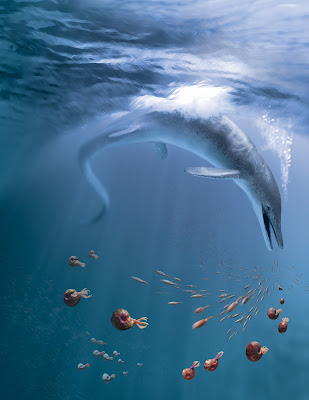
Reconstrucción de Cymbospondylus youngorum hecha por mi talentosa colega Stephanie Abramowicz (aquí pueden ver algunos de sus otros trabajo).

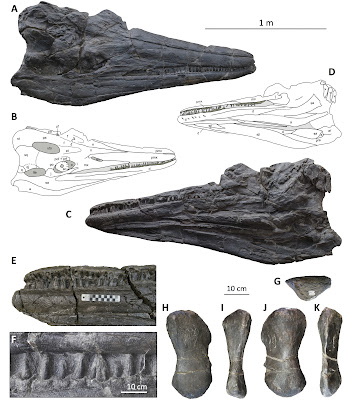
Con un cráneo de alrededor dos metros de largo, estimamos que el cuerpo de Cymbospondylus youngorum alcanzaba un largo de alrededor de 17 metros, lo cual es cerca al tamaño de los cachalote (Physeter macrocephalus), y unos cuantos metros más pequeño que el icitiosaurio nombrado más grande, Shonisaurus sikanniensis, que se estima medía alrededor de 21 metros (Nicholls and Manabe, 2004; Sander et al., 2021). En adición a S. sikanniensis, se han encontrado restos de otros ictiosaurios más grandes, con tamaños que se acercan a los 25 metros (Lomax et al., 2018), pero tanto estos, como S. sikanniensis, son del Triásico tardío, o sea, geocronológicamente más jóvenes que C. youngorum.
El holotipo de Cymbospondulus youngorum: vistas dorsal (A-B) y ventral (C-D) del cráneo y mandíbula; detalle de la dentadura (E-F), y húmero (H-K). El cráneo se encuentra actualmente en exhibición en el Museo de Historia Natural del Condado de Los Angeles.

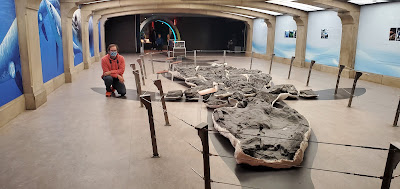
El holotipo de Shonisaurus sikanniensis, el cual tuve la oportunidad de ver en una visita reciente al Royal Tyrrell Museum en Alberta, Canada.

La Fauna de Fossil Hill representa el conjunto más diverso de ictiosarios que se conoce al momento, con especies que van desde los dos a 17 metros de largo. Esto tomó lugar alrededor de 246 millones de años atrás, apenas unos seis millones después de la extinción Permo-Triásica, (la peor de la historia y donde se extinguió alrededor de 90% de las especies en el planeta) e, interesantemente, unos tres millones de años desde que aparecen los primeros ictiosaurios . Todo esto sugiere una pronta recuperación en los océanos y que los icitiosaurios se diversificaron y alcanzaron tamaños enormes rápidamente. Con esta información en mano, decidimos explorar en mayor detalle la estructura e interacciones tróficas (quién se come a quién) en este antiguo ecosistema y tazas evolutivas en los ictiosaurios.

Además de los reptiles marinos, la Fauna de Fossil Hill incluye peces, conodontes, ammonites y posiblemente coleoideos (cefalópodos sin concha). Una de las preguntas principales que nos hicimos sobre este ecosistema antiguo fue cuan estable era este ecosistema dominado por depredadores (i.e. los ictiosaurios) aún cuando todavía no existían los productores primarios que encontramos actualmente en los océanos. Para contestar esta pregunta estimamos la masa corporal, número de individuos y requerimientos energéticos de las especies de la Fauna de Fossil Hill y usamos esa información para explorar distintos modelos computacionales de flujo de energía para determinar la estabilidad de esa red trófica. 

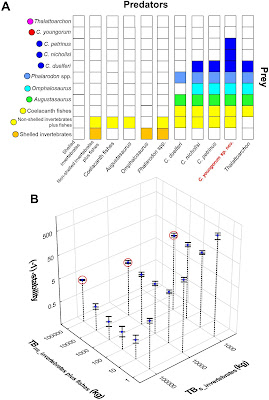
Arriba, matriz de interacciones tróficas (quién se come a quién) que utilizamos para establecer los modelos de flujo de energía entre los miembros de la Fauna de Fossil Hill.
Abajo, gráfica con los valores obtenidos con los distintos modelos de red trófica que usamos. Los distintos resultados son en base a los valores que estimamos para el total de la biomasa para peces e invertebrados con partes duras. 

Los resultados de este análisis confirmaron que el ecosistema de la Fauna de Fossil Hill si era estable, aún si solo consideramos a los amonites como los principales productores primarios y que la cadena alimenticia era más corta en comparación a las actuales. Otro aspecto interesante de esta parte de nuestro estudio es que los resultados sugieren que había comida suficiente para la presencia (hipotética) de una especie adicional de ictiosaurio gigante que consumiera alimento a granel (bulk feeding/filter feeding), como hacen los misticetos (ballenas barbadas).

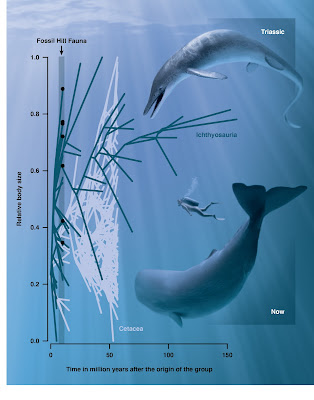
El otro análisis que hicimos fue comparar las tazas de evolución de gigantismo entre ictiosaurios y cetáceos. Para esto hicimos unos análisis utilizando filogenias calibradas y estimados de tamaño de cuerpo para la mayor cantidad de especies posible de ambos grupos, que en el caso de los ictiosaurios logramos incluir 48 especies y 269 especies de cetáceos. El resultado principal de este análisis fue concluir que los ictiosaurios alcanzaron tamaños gigantes bien temprano y bien rápido en su historia evolutiva! El tiempo transcurrido desde su origen al momento que alcanzaron tamaños gigantes fue mucho más corto que en los cetáceos, que como sabemos, también alcanzaron tamaños gigantes, pero a lo largo de un periodo más largo de tiempo. En ambos grupos se detectaron aumentos en el tamaño de cuerpo en más de una ocasión, y en algunos grupos de cetáceos también observamos disminución en tamaño, particularmente en los Kogiidae (los cachalotes pigmeos y parientes extintos). 

Gráfica comparando la taza de evolución de tamaño de cuerpo entre ictiosaurios (líneas azules) y cetáceos (líneas blancas). El eje 'Y' representa los valores de tamaño de cuerpo (aumentan hacia arriba), mientras que el eje 'X' es el tiempo transcurrido (en millones de años) desde el origen de los grupos. Aquí también se puede ver la similitud en tamaño entre Cymbospondylus youngorum (arriba a la derecha) y un cachalote (abajo a la derecha).

Previamente se habían publicado trabajos enfocados en la evolución de gigantismo en los misticetos (ballenas barbadas) y nuestros resultados son congruentes con los de ese estudio (Slater et al., 2017). Sin embargo, nuestro trabajo es el primero en examinar la evolución de tamaño de cuerpo que incluye todos los grupos de cetáceos, desde los más antiguos hasta los actuales. Nuestros resultados sugieren además que la evolución de gigantismo en los cetáceos está relacionado con cambios en la alimentación. En el caso de los misticetos parece relacionarse con la pérdida de dientes y alimentación a granel (bulk feeding), mientras que en los odontocetos con alimentación raptorial y búsqueda de presas a grandes profundidades.

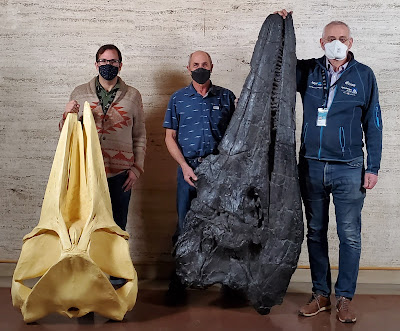
De izquierda a derecha: yo con una réplica del cráneo de un rorcual Minke (Balaenoptera acutorostrata), al centro Tom Young quien junto con su esposa son los fundadores de Great Basin Brewing Co. y a la derecha Martin Sander (University of Bonn), uno de los autores principales del trabajo, con una réplica del cráneo de Cymbospondylus youngorum. El epíteto específico "youngorum" es en honor a los Young por su apoyo a los proyecto de Martin en Nevada y a nuestro museo.

Como investigadores frecuentemente nos gusta comparar ictiosaurios con cetáceos, así que este proyecto fue muy satisfactorio ya que logramos investigar y comparar detalladamente algunos de los aspectos evolutivos que comparten ambos grupos. Para este proyecto utilizamos una combinación de métodos paleontológicos tradicionales (descripciones, medidas y observaciones, etc.) y modelos computacionales lo cual facilitó la exploración de patrones macroevolutivos usando el registro fósil de estos tetrápodos marinos. Nuestros resultados, como ya mencioné, fueron muy interesantes y no hubiese sido posible sin el diverso equipo de expertos en nuestro grupo de trabajo. Aún así, este fue un primer paso ya que queda mucho más por conocer de estos antiguos ecosistemas marinos y evolución de tamaño de cuerpo en otros grupos de vertebrados que se readaptaron a una vida en el mar.

Referencias

Fröbisch, N. B., P. M. Sander, and O. Rieppel. 2006. A new species of Cymbospondylus (Diapsida, Ichthyosauria) from the Middle Triassic of Nevada and a re-evaluation of the skull osteology of the genus. Zoological Journal of the Linnean Society 147:515–538.

Fröbisch, N. B., J. Fröbisch, P. M. Sander, L. Schmitz, and O. Rieppel. 2013. Macropredatory ichthyosaur from the Middle Triassic and the origin of modern trophic networks. Proceedings of the National Academy of Sciences 110(4):1393–1397.

Klein, N., L. Schmitz, T. Wintrich, and P. M. Sander. 2020. A new cymbospondylid ichthyosaur (Ichthyosauria) from the Middle Triassic (Anisian) of the Augusta Mountains, Nevada, USA. Journal of Systematic Palaeontology 18(14):1167–1191.

Leidy, J. 1868. Notice of some reptilian remains from Nevada. Proceedings of the Philadelphia Academy of Sciences 20:177–178.

Lomax, D. R., P. De la Salle, J. A. Massare, and R. Gallois. 2018. A giant late Triassic ichthyosaur from the UK and a reinterpretation of the Aust Cliff 'dinosaurian' bones. PLoS ONE 13(4):e0194742.

Merriam, J. C. 1906. Preliminary note on a new marine reptile from the Middle Triassic of Nevada. University of California Publications–Bulletin of the Department of Geology 5:5–79.

Merriam, J. C. 1910. The skull and dentition of a primitive ichthyosaurian from the Middle Triassic. University of California Publications–Bulletin of the Department of Geology 5:381–390.

Nicholls, E. L., and M. Manabe. 2004. Giant ichthyosaurs of the Triassic—a new species of Shonisaurus from the Pardonet Formation (Norian:late Triassic) of British Columbia. Journal of Vertebrate Paleontology 24:838–849.

Sander, P. M., O. C. Rieppel, and H. Bucher. 1997. A new pistosaurid (Reptilia:Sauropterygia) from the Middle Triassic of Nevada and its implications for the origin of the plesiosaurs. Journal of Vertebrate Paleontology 17(3):526–533.

Sander, P. M., E. M. Griebeler, N. Klein, J. Velez-Juarbe, T. Wintrich, L. J. Revell, and L. Schmitz. 2021. Early giant reveals faster evolution of large size in ichthyosaurs than in cetaceans. Science 374:eabf5787.

Schmitz, L., P. M. Sander, G. W. Storrs, and O. Rieppel. 2004. New Mixosauridae (Ichthyosauria) from the Middle Triassic of the Augusta Mountains (Nevada, USA) and their implications for mixosaur taxonomy. Palaeontographica Abt. A 270:133–162.

Slater, G. J., J. A. Goldbogen, and N. D. Pyenson. 2017. Independent evolution of baleen whale gigantism linked to Plio-Pleistocene ocean dynamics. Proceedings of the Royal Society B 284:20170546.

Friday, December 24, 2021

The First Ocean Giant

When we think of ocean giants we usually think of whales, which indeed include the largest animal known to have lived in our planet, the blue whale (Balaenoptera musculus) reaching lengths of up to 29 meters (95 feet). Things were not so different during the Mesozoic, the so-called 'Age of Dinosaurs', when the oceans had various groups of large marine tetrapods, mainly ichthyosaurs, pliosaurs and mosasaurs. Amongst these different groups of Mesozoic marine reptiles, ichthyosaurs hold the record for the largest to have swam in the Mesozoic seas. Now, in my most recent paper published yesterday in Science, we describe the first giant ichthyosaur, which also turned out to be the first giant vertebrate in Earth's history. The new species, named Cymbospondylus youngorum, was discovered in Middle Triassic (~242-247 million years ago) deposits in central Nevada and is part of an icthyosaur-rich fauna (AKA Fossil Hill Fauna) that includes at least seven other species of ichthyosaurs and the pistosauroid Augustasaurus hagdorni (Leidy, 1868; Merriam, 1906, 1910; Sander et al., 1997; Schmitz et al., 2004; Fröbisch et al., 2006; Fröbisch et al., 2013; Klein et al., 2020; Sander et al., 2021).

Life reconstruction of Cymbospondylus youngorum by my very talented colleague Stephanie Abramowicz (you should check out her other work here).

With a skull that's about two meters long, Cymbospondylus youngorum has an estimated body length of about 17 meters which is close to that of extant sperm whales (Physeter macrocephalus), and several meters smaller than the largest named ichthyosaur Shonisaurus sikanniensis which had a body length of 21 meters (Nicholls and Manabe, 2004; Sander et al 2021). There are fragmentary remains of larger ichthyosaurs, with body lengths estimates close to 25 meters (Lomax et al., 2018), but these, as well as S. sikanniensis, are from late Triassic deposits, hence geochronologically younger than C. youngorum.
The holotype of Cymbospondulus youngorum; dorsal (A-B) and ventral (C-D) views of the skull; closeup of the teeth (E-F), and humerus (H-K). The skull is currently on exhibit at the Natural History Museum of Los Angeles County.

The holotype of Shonisaurus sikanniensis, seen on a recent visit to the Royal Tyrrell Museum in Alberta, Canada.

The Fossil Hill Fauna represents the most diverse ichthyosaur assemblage known, with species ranging from 2 to 17 meters. Interestingly, this is taking place about 246 million years ago, a mere six million years after the Permo-Triassic extinction, when about 90% of organism in our planet became extinct, and 3 million years after the appearance of the first ichthyosaurs. This suggest a speedy recovery for life in the oceans, and very fast diversification and body size increase in ichthyosaurs, and made us wonder about the structure and trophic interactions in this ancient ecosystem.

Besides the marine tetrapods, the Fossil Hill Fauna includes fishes, conodonts, ammonoids and most likely coleoids (shell-less cephalopods). One of the big questions with regards to this ancient ecosystem was, how sustainable was this predator-rich environment in the absence of modern primary producers? To answer this we explored energy flux models by estimating body masses, number of individuals and energy requirements for the Fossil Hill Fauna to test food web stability. 

Top, trophic interaction matrix used for modeling energy flux amongst members of the Fossil Hill Fauna. Bottom, graphic showing values for each different food web models. Variation between the different models are based on different estimates of total biomass for "shelled invertebrates and "fish". (See our supplementary material for a more detailed explanation of the models.)

The short answer is yes, the Fossil Hill Fauna was stable, even if taking the ammonites as the sole primary producers. More interestingly, our results suggest that this fauna could still sustain additional marine tetrapods, including a hypothetical filter or bulk feeding ichthyosaur!

Our other big analysis was to compare body size evolution in ichthyosaurs and whales. For this we used time-calibrated phylogenies and body size datasets for both groups to explore body size evolution over time in these two, somewhat similar, groups of secondarily aquatic tetrapods. The big takeaway from our analysis is that ichthyosaurs got really big, really early in their evolutionary history, at a rate unmatched by cetaceans which got big at slower rates. Body size increases occurred multiple times in both groups, and we also detected body size decreases in some cetacean lineages, such as kogiids (pygmy and dwarf sperm whales and their extinct relatives). 

Comparison of body size evolution in ichthyosaurs vs cetaceans. The 'Y' axis shows relative body size (greater towards the top) and the 'X' axis is time since the origin of the different groups.

Previous work on cetacean body size evolution had focused on mysticetes (baleen whales), and our results are congruent with those studies (Slater et al., 2017). However, this was a first take on body size evolution on cetaceans as a whole, with some interesting results for odontocetes. Broadly, the evolution of large body sizes in cetaceans seems to be linked to feeding specializations, loss of teeth and bulk feeding in mysticetes and raptorial feeding and deep diving in odontocetes.

From left to right: myself with a cast of a Minke whale (Balaenoptera acutorostrata) skull, Tom Young and lead author Martin Sander (University of Bonn) with a cast of the skull of Cymbospondylus youngorum. The specific epithet of the new species is after Tom and his wife Bonda owners of Great Basin Brewing Co., and supporters of Martin's work in Nevada.

As researcher we often compare ichthyosaurs and cetaceans, so this project was extremely satisfying as we were able to really dive into some of the overlapping aspects of their evolutionary history. Our approach combined traditional paleontological methods with computational modeling bringing together a group of experts in different fields which allowed us to explore macroevolutionary patterns in these groups. While our results are very exciting, this work is a stepping stone as there is still a lot to understand about ancient marine ecosystems and body size evolution across other groups of secondarily aquatic tetrapods. 

Literature Cited

Fröbisch, N. B., P. M. Sander, and O. Rieppel. 2006. A new species of Cymbospondylus (Diapsida, Ichthyosauria) from the Middle Triassic of Nevada and a re-evaluation of the skull osteology of the genus. Zoological Journal of the Linnean Society 147:515–538.

Fröbisch, N. B., J. Fröbisch, P. M. Sander, L. Schmitz, and O. Rieppel. 2013. Macropredatory ichthyosaur from the Middle Triassic and the origin of modern trophic networks. Proceedings of the National Academy of Sciences 110(4):1393–1397.

Klein, N., L. Schmitz, T. Wintrich, and P. M. Sander. 2020. A new cymbospondylid ichthyosaur (Ichthyosauria) from the Middle Triassic (Anisian) of the Augusta Mountains, Nevada, USA. Journal of Systematic Palaeontology 18(14):1167–1191.

Leidy, J. 1868. Notice of some reptilian remains from Nevada. Proceedings of the Philadelphia Academy of Sciences 20:177–178.

Lomax, D. R., P. De la Salle, J. A. Massare, and R. Gallois. 2018. A giant late Triassic ichthyosaur from the UK and a reinterpretation of the Aust Cliff 'dinosaurian' bones. PLoS ONE 13(4):e0194742.

Merriam, J. C. 1906. Preliminary note on a new marine reptile from the Middle Triassic of Nevada. University of California Publications–Bulletin of the Department of Geology 5:5–79.

Merriam, J. C. 1910. The skull and dentition of a primitive ichthyosaurian from the Middle Triassic. University of California Publications–Bulletin of the Department of Geology 5:381–390.

Nicholls, E. L., and M. Manabe. 2004. Giant ichthyosaurs of the Triassic—a new species of Shonisaurus from the Pardonet Formation (Norian:late Triassic) of British Columbia. Journal of Vertebrate Paleontology 24:838–849.

Sander, P. M., O. C. Rieppel, and H. Bucher. 1997. A new pistosaurid (Reptilia:Sauropterygia) from the Middle Triassic of Nevada and its implications for the origin of the plesiosaurs. Journal of Vertebrate Paleontology 17(3):526–533.

Sander, P. M., E. M. Griebeler, N. Klein, J. Velez-Juarbe, T. Wintrich, L. J. Revell, and L. Schmitz. 2021. Early giant reveals faster evolution of large size in ichthyosaurs than in cetaceans. Science 374:eabf5787.

Schmitz, L., P. M. Sander, G. W. Storrs, and O. Rieppel. 2004. New Mixosauridae (Ichthyosauria) from the Middle Triassic of the Augusta Mountains (Nevada, USA) and their implications for mixosaur taxonomy. Palaeontographica Abt. A 270:133–162.

Slater, G. J., J. A. Goldbogen, and N. D. Pyenson. 2017. Independent evolution of baleen whale gigantism linked to Plio-Pleistocene ocean dynamics. Proceedings of the Royal Society B 284:20170546.

Wednesday, July 9, 2014

Its the 10th installment of Fossil Sirenia of the West Atlantic and Caribbean Region!

Today came out the most recent issue of the Journal of Vertebrate Paleontology. Amongst many other interesting papers, there is one by yours truly and former PhD advisor Daryl Domning. In our paper we describe a new sirenian taxon from early Oligocene deposits in Puerto Rico and South Carolina, its our second new species this year, as some months ago we published the description of Metaxytherium albifontanum Velez-Juarbe and Domning, 2014 (read more about it here). The fossil from Puerto Rico, which is fairly complete, comes from the same overall locality as some other fossils I've mentioned in previous posts, like Aktiogavialis puertoricensis Velez-Juarbe et al., 2007, and the oldest West Indian rodent (Velez-Juarbe et al., 2014).  This paper also marks the Tenth (!!!!) installment of the series on Fossil Sirenia of the West Atlantic and Caribbean Region, which Daryl started in 1988 (Domning, 1988)! Such long-lasting series are very uncommon!

The last time a new species of sirenian was described from Puerto Rico was 1959, when Roy H. Reinhart in his monumental work on Sirenia and Desmostylia, described Caribosiren turneri (see picture below) from the San Sebastian Formation in the northwestern part of the island. Caribosiren is a weird dugongid, it has a rostral deflection (downturning of the snout) of nearly 90º, and apparently no tusks!!
Caribosiren turneri Reinhart, 1959, from the San Sebastian Formation of Puerto Rico. Notice the extremely downturned snout  which always reminds me of Gonzo! The tip of the snout, although not preserved very well, hints at a lack of tusks.
(Photo courtesy of N.D. Pyenson) (Click on image to see larger version.)
The new fossil is from the same formation as Caribosiren. We named our new species Priscosiren atlantica, in reference to its ancestral relationship to other fossil dugongids (prisco means ancient, former) and its occurrence in the Western Atlantic region.
Priscosiren atlantica is known from multiple elements of two individuals, one from the Puerto Rico (USNM 542417) the other from South Carolina (SC 89.254). Its one of the most complete early Oligocene sirenians known. (Outline of skeleton modified from Cope, 1890).
(Click on image to see larger version.)

Slides from a talk that Daryl and I gave at the 2013 SVP annual meeting. Here we point out to several of the characters that diagnose Priscosiren atlantica as well as its relationship to other dugongids.
(Click on image to see larger version.)
 Priscosiren is represented by at least two individuals (an adult and a subadult), with associated cranial and postcranial material, making it one of the best known early Oligocene sirenians. This species occupies a special place amongst other dugongids as it seems to be ancestral (hence its name) to a clade that includes Metaxytherium spp. + Hydrodamalinae, and Dugonginae (see above). More interestingly, is that Priscosiren is found in the same formation as Caribosiren in Puerto Rico, and Crenatosiren olseni in South Carolina, and hints at the presence of sirenian multispecies communities (Velez-Juarbe et al., 2012) during the early Oligocene.

The day we found the holotype specimen of Priscosiren (USNM 542417) was the same day we found the holotype of Aktiogavialis puertoricensis, which we were able to collect that same day. In contrast, collecting Priscosiren was an ordeal, it is a long story, of discovery, failed attempts at collecting it, loss of parts, and final recovery. So stay tuned for an upcoming post about that story!

References

Domning, D. P. 1988. Fossil Sirenia of the West Atlantic and Caribbean Region. I. Metaxytherium floridanum Hay, 1922. Journal of Vertebrate Paleontology 8:395-426.

Reinhart, R. H. 1959. A review of the Sirenia and Desmostylia. University of California Publications in Geological Sciences 36(1):1-146.

Velez-Juarbe, J., C. A. Brochu, and H. Santos. 2007. A gharial from the Oligocene of Puerto Rico: transoceanic dispersal in the history of a nonmarine reptile. Proceedings of the Royal Society B 274:1245-1254.

Velez-Juarbe, J., and D. P. Domning. 2014. Fossil Sirenia of the West Atlantic and Caribbean Region. IX. Metaxytherium albifontanum. Journal of Vertebrate Paleontology 34:444-464.

Velez-Juarbe, J., and D. P. Domning. 2014. Fossil Sirenia of the West Atlantic and Caribbean Region. X. Priscosiren atlantica gen. et sp. nov. Journal of Vertebrate Paleontology 34:951-964.

Velez-Juarbe, J., D. P. Domning, and N. D. Pyenson. 2012. Iterative evolution of sympatric seacow (Dugongidae, Sirenia) assemblages during the past ~26 million years. PLoS ONE 7:e31294.

Velez-Juarbe, J., T. Martin, R. D. E. MacPhee, and D. Ortega-Ariza. 2014. The earliest Caribbean rodents: Oligocene caviomorphs from Puerto Rico. Journal of Vertebrate Paleontology 34:157-163.

Wednesday, March 5, 2014

Florida gets a new species of fossil seacow!

Yesterday saw the publication (online) of the second issue of 2014 of Journal of Vertebrate Paleontology. Published in this issue is the description of the first new species of seacow from the Western Atlantic that I get to name. In collaboration with Daryl P. Domning, this is the latest installment in the series titled "Fossil Sirenia of the West Atlantic and Caribbean Region" which Daryl started in 1988 (Domning, 1988). Our new species, named Metaxytherium albifontanum is known from late Oligocene deposits in Florida and South Carolina. The generic name albifontanum translates into white springs (albus = white; fontanus = spring or fountain). But why did we choose that name? and what is Metaxytherium? Keep reading and you'll find out why and more. 

Scientific Names
The scientific name of organisms consist of two parts: the genus and the species. The genus is a more inclusive rank, whereas the species is more unique. In a way, you can think of the genus name as an equivalent to your last name, where there will be more members (e.g. siblings and/or parents) with that same last name, and the species name as your first name; the two, together, will form a unique combination which applies only to you. We use scientific names in order to infer relationships amongst organisms, and these are usually latinized so that they can be understood by anyone, anywhere, as a common language, instead of using the common name which changes by country and language. Now, when describing a new species and giving it a scientific name, you can choose whichever name you think appropriate, as long as its not your own (Linnaeus was the one exception; there are other rules for naming, which you can find here). You can name a species after a musician who was an inspiration, the country where it was found, or in honor of a fellow researcher, just to name a few examples.
Renowned paleontologist George Gaylord Simpson named several fossil sirenians from Florida (Simpson, 1932). Simpson had a thing for using cleverly latinized versions of formation or locality names for his new species. For example, he described some fossils from the Bone Valley district in central Florida and gave them the scientific name Felsinotherium ossivallense*, (ossivallense = Bone Valley), while another one he named Hesperosiren crataegensis*, which takes its name from Crataegus, the genus name of a plant commonly known as hawthorn, which in turn is also the name of the sedimentary unit, the Hawthorn Group, where Simpson's specimen was found. So, as a homage to G. G. Simpson and his work on the fossil sirenians from Florida we decided to use a latinized version of the name of the town of White Springs, FL, which is close to where the holotype (= name-bearing specimen) of our new species was collected; resulting in the combination Metaxytherium albifontanum.
*both Felsinotherium and Hesperosiren were later synonymized with Metaxytherium


Metaxytherium albifontanum is known from multiple elements of several individuals (each color identifies elements represented by one or more specimens; white = unknown). This makes it one of the most complete fossil sirenians known. (Outline of skeleton modified from Cope, 1890). (Click on the image to see larger version.)
What is Metaxytherium
Metaxytherium is a widespread and relatively well-known genus of fossil dugongid. There are now a total of eight species under this genus, it has a wide temporal distribution, ranging from the late Oligocene through early Pliocene, and a broad geographical distribution, with species known from Europe, northern Africa, and the Americas. Most of the species known were described and named between 1822 and the first half of the 1900's, so, unexpectedly, there was a bit of a taxonomic mess (this happens more often than we'd like). Fortunately, since 1987, there have been several papers providing us with detailed descriptions of some of the known species, as well as phylogenetic analyses (e.g. Domning and Thomas, 1987; Domning, 1988; Aranda-Manteca et al., 1994; Domning and Pervesler, 2001; Sorbi, 2008; Sorbi et al., 2012). These works have help clarify some of the taxonomic confusion surrounding some of the old names, and even a new species was described, Metaxyterium arctodites Aranda-Manteca et al., 1994, from Baja California and California. That makes M. albifontanum the first species of Metaxytherium named in 20 years!! Meaning that we are not done learning about the diversity of this group, and more may still be waiting to be described.


Slides from a talk Daryl and I gave at the Society of Vertebrate Paleontology 2013 Annual Meeting. Here we use M. albifontanum to illustrate some of the features that characterize the genus Metaxytherium (top two and bottom left). The phylogenetic tree on the bottom right shows the relationship between Metaxytherium spp. and other sirenians (modified from figure 15 of our paper). (Click on the image to see larger version.) 
Our new species differed from all other known species in the group. Not only that, it is the geologically oldest species of Metaxytherium. Previous assumptions on the origins of Metaxytherium had hypothesized an European origin for the group, our discovery changes that and seems to indicate a Western Atlantic origin for the genus.

Relationships with Other Species
One of the relevant results of our paper is that we got to properly define Metaxytherium. Our phylogenetic analysis (see tree above, bottom right) was consistent with previous work (e.g. Domning, 1994), showing a close relationship between Metaxytherium spp. and hydrodamalines (the group that include Steller's seacow). We also got some interesting results regarding the relationships amongst the different species of Metaxytherium. Our results indicate that the split between Metaxytherium albifontanum and the geologically younger M. krahuletzi (from the early Miocene of Europe), occurred before the late Oligocene, as the latter occupies a more basal position within the tree. The relationships within the group also seem to point to multiple dispersals across the Atlantic and/or a high degree in morphological convergence.

Paleoecology
Metaxytherium albifontanum was part of a sirenian multi-species assemblage in the late Oligocene of Florida, together with Dioplotherium manigaulti and Crenatosiren olseni. As part of that assemblage, we hypothesize M. albifontanum as a consumer of small-sized seagrasses such as eelgrass, while the other species likely fed on larger species. If this sounds familiar is because I wrote about this subject in a previous post. In fact, M. albifontanum was one of the species that inspired the iterative evolution project with Daryl and Nick Pyenson, which resulted in our open access publication in PLoS ONE (Velez-Juarbe et al., 2012). 

Assorted Random Musing: 
  • I visited the Florida Museum of Natural History in 2011 to study one of the specimens (UF 49051), little did I know at that time that I would end up as a Postdoc here!
  • You can see the name-bearing specimen, UF 49051, in the Florida Fossils: Evolution of Life and Land exhibit at the Florida Museum of Natural History.
  • It so happened that I wrote this post from a desk at the Simpson Library of Paleontology, its filled with books and reprints donated by him, and...
  • There are a lot of pictures of Simpson in this library, in some, he kind of looks like the long lost brother of Colonel Sanders...
Stay tuned as more new fossils seacows will be showing up here later this year!!

References

Aranda-Manteca, F. J., D. P. Domning, and L. G. Barnes. 1994. A new Middle Miocene sirenian of the genus Metaxytherium from Baja California: relationships and paleobiogeographic implications. Proceedings of the San Diego Society of Natural History 29:191-204.

Cope, E. D. 1890. The extinct Sirenia. American Naturalist 24:697-702.

Domning, D. P. 1988. Fossil Sirenia of the West Atlantic and Caribbean Region. I. Metaxytherium floridanum Hay, 1922. Journal of Vertebrate Paleontology 8:395-426.

Domning, D. P. 1994. A phylogenetic analysis of the Sirenia. Proceedings of the San Diego Society of Natural History 29:177-189.

Domning, D. P., and P. Pervesler. 2001. The osteology and relationships of Metaxytherium krahuletzi Depéret, 1895 (Mammalia: Sirenia). Abhandlungen der Senckenbergischen Naturforschenden Gesellschaft 553:1-89.

Domning, D. P., and H. Thomas. 1987. Metaxytherium serressii (Mammalia: Sirenia) from the early Pliocene of Libya and France: a reevaluation of its morphology, phyletic position, and biostratigraphic and paleoecological significance; pp. 205-232 in N. Boaz, A. El-Arnauti, A. W. Gaziry, J. de Heinzelin, and D. D. Boaz (eds.), Neogene Paleontology and Geology of Sahabi. New York (Liss).

Simpson, G. G. 1932. Fossil Sirenia of Florida and the evolution of the Sirenia. Bulletin of the American Museum of Natural History 59:419-503.

Sorbi, S. 2008. New record of Metaxytherium (Mammalia, Sirenia) form the lower Miocene of Manosque (Provence, France). Geodiversitas 30:433-444.

Sorbi, S., D. P. Domning, S. C. Vaiani, and G. Bianucci. 2012. Metaxytherium subapenninum (Bruno, 1839) (Mammalia, Dugongidae), the latest sirenian of the Mediterranean Basin. Journal of Vertebrate Paleontology 32:686-707.

Velez-Juarbe, J., and D. P. Domning. 2014. Fossil Sirenia of the West Atlantic and Caribbean Region. IX. Metaxytherium albifontanum sp. nov. Journal of Vertebrate Paleontology 34:444-464.

Velez-Juarbe, J., D. P. Domning, and N. D. Pyenson. 2012. Iterative evolution of sympatric seacow (Dugongidae, Sirenia) assemblages during the past ~26 million years. PLoS ONE 7:e31294.

Tuesday, June 9, 2009

From land to sea

Some of the living marine mammals, like cetaceans, sirenians and pinnipeds* are so well adapted to a life in water that it might be difficult for us to relate them to their closest terrestrial relatives. However, we do know that the oldest members of these groups were indeed terrestrial. Here I’ll discuss some of the evidence known so far.

*(cetaceans = whales & dolphins; sirenians = manatees & dugongs; pinnipeds = seals, walruses & sea lion).

Cetaceans

Modern whales can be divided into two groups, odontocetes and mysticetes. Odontocetes are characterized for having teeth and using echolocation; mysticetes are characterized for having baleen instead of teeth (there are other adaptations that I won’t discuss now). Some examples of odontocetes are orcas and bottlenose dolphins; mysticetes include blue whales and right whales.

Based on molecular evidence, whales evolved from artiodactyls – a group that includes pigs, hippopotamus, camels, cows, lambs, etc – (Graur & Higgins, 1994; Shimamura et al., 1997), whereas, for a long time, morphological studies used to indicate a close relationship with mesonychids – a group of extinct terrestrial carnivores – (Luo & Gingerich, 1999). In part, the reason for this disagreement about the origin of whales was that the oldest fossils of cetaceans consisted of forms that were already completely adapted to a life in the water, or were only known from crania. This has already been resolved.

In 2001, two groups of paleontologist published papers where they described primitive cetaceans, including parts of the postcranium that corroborated an artiodactyl relationship (Gingerich et al., 2001; Thewissen et al., 2001). Gingerich and his team found remains of Artiocetus clavis and Rhodocetus balochistanensis, whereas the Thewissen team described Ichthyolestes pinfoldi and Pakicetus attocki (illustration above of Pakicetus by Carl Buell, taken from the Thewissen Lab webpage); the remains included one of the ankle bones, the astragalus, which was key to determine that cetaceans evolved from artiodactyls. All these fossils were found Middle Eocene (49-41 million years ago) deposits. More recently, Thewissen et al. (2007) describe postcranial material of the primitive artiodactyl, Indohyus, and show that it was an animal with aquatic adaptations, providing additional evidence about the origin of cetaceans. (Go here for a magnificent reconstruction of Indohyus).

Sirenians

The closest living relatives of manatees and dugongs are elephants, this relationships is supported by both, molecular and morphological evidence (Seiffert, 2007; Tabuce et al. 2007). Sirenians originated in northern Africa about 54 million years ago, where they last shared a common ancestor with proboscideans (elephants). Interestingly, the most primitive sirenian fossils have been found in Jamaica, which demonstrate that, very early, they seem to have been well adapted for life in an aquatic environment. For a long time, the most primitive sirenian known was Prorastomus sirenoides found in Jamaica in deposits that are between 51-49 million years old (Owen, 1855; Savage et al., 1994). Unfortunately, the postcranium was and it is still mostly unknown.

Another sirenian from Jamaica, found in slightly younger deposits – 49-45 million years old – was described by Domning (2001). The remains of this new sirenian, named Pezosiren portelli (illustration above from Domning, 2001), include cranial and postcranial material. The postcranial material include fore and hind limbs, pelvis and most of the vertebral column; all together, these indicate that Pezosiren was able to support its own weight on land, but at the same time, it had aquatic adaptations such as pachyosteosclerotic (enlarged & dense) ribs and in the cranium, retracted external nares (Domning, 2001). The combination of characters imply that Pezosiren spent time, both, in and out of the water.

Pinnipeds

Morphological and molecular studies show that pinnipeds belong to a group of mammals called arctoids (Deméré et al., 2003), that, along with pinnipeds, includes bears (ursids), weasels (mustelids), raccoons (procyonids) and skunks (mephitids), among others. Nonetheless, the origin of pinnipeds from one of these arctoids is not clear, and different studies place pinnipeds as originating from a common ancestor with mustelids or with ursids (Deméré et al., 2003). Other experts in the field support a multiple origin for pinnipeds, with seals sharing a common ancestor with mustelids and sea lion and walruses with ursids (Uhen, 2007 and references therein). Anyways, whatever is the group from which pinnipeds originated – this can only be resolved by finding more fossils – it is well known that these originate from a terrestrial ancestor. Interestingly, pinniped fossils that show a transitional morphology had not been found until recently.

The discovery of Puijila darwini in lacustrine sediments deposited between 23-21 million years ago, gives us an idea about the morphology of the earliest pinnipeds (Rybczynski et al., 2009). Although fossils of yet even older pinnipeds, such as Enaliarctos tedfordi and E. barnesi, have been found in rocks that date between 28.5-23.8 million years in Oregon (Deméré et al., 2003), these already show full adaptations to a life in the marine realm like those observed in modern taxa; this means that pinnipeds must have evolved previous to that date. So, even if Puijila (illustration above from Rybczynski et al., 2009) comes from younger deposits, its importance rests in that morphologically it is the most primitive known pinnipeds, providing evidence about the evolutionary steps that were taken in the transition from land to sea in this group of mammals.

Puijila the official website

Puijila in National Geographic

Also, here is the Spanish version of this post.

References

Deméré, T. A., A. Berta & P. J. Adams. 2003. Pinnipedomorph evolutionary biogeography. Bulletin of the American Museum of Natural History 279:32-76.

Domning, D. P. 2001. The earliest known fully quadrupedal sirenian. Nature 413:625-627.

Gingerich, P. D., M. ul Haq, I. S. Zalmout, I. H. Khan & M. S. Malkani. 2001. Origin of whales from early artiodactyls: hands and feet of Eocene Protocetidae from Pakistan. Science 293:2239-2242.

Graur, D. & D. G. Higgins. 1994. Molecular evidence for the inclusion of cetaceans within the order Artiodactyla. Molecular Biology and Evolution 11(3):357-364.

Luo, Z. & P. D. Gingerich. 1999. Terrestrial Mesonychia to aquatic Cetacea: transformation of the basicranium and evolution of hearing in whales. University of Michigan Papers on Paleontology 31:1-98.

Owen, R. 1855. On the fossil skull of a mammal (Prorastomus sirenoides, Owen), from the island of Jamaica. Quarterly Journal of the Geological Society of London 11:541-543.

Rybczynski, N., M. R. Dawson & R. H. Tedford. 2009. A semi-aquatic Arctic mammalian carnivore from the Miocene epoch and origin of Pinnipedia. Nature 458:1021-1024.

Savage, R. J. G., D. P. Domning & J. G. M. Thewissen. 1994. Fossil Sirenia of the West Atlantic and Caribbean region. V. Prorastomus sirenoides Owen, 1855. Journal of Vertebrate Paleontology 14(3):427-449.

Seiffert, E. R. 2007. A new estimate of afrotherian phylogeny based on simultaneous analysis of genomic, morphological, and fossil evidence. BMC Ecolutionary Biology 7:224 Open access

Shimamura, M., H. Yasue, K. Ohshima, H. Abe, H. Kato, T. Kishiro, M. Goto, I. Munechika & N. Okada. 1997. Molecular evidence from retroposons that whales form a clade within even-toed ungulates. Nature 388:666-670.

Tabuce, R., L. Marivaux, M. Adaci, M. Bensalah, J.-L. Hartenberger, M. Mahboubi, F. Mebrouk, P. Tafforeau & J.-J. Jaeger. 2007. Early Tertiary mammals from North Africa reinforce the molecular Afrotheria clade. Proceedings of the Royal Society B 274:1159-1166.

Thewissen, J. G. M., E. M. Williams, L. J. Roe & S. T. Hussain. 2001. Skeletons of terrestrial cetaceans and the relationship of whales to artiodactyls. Nature 413:277-281.

Thewissen, J. G. M., L. N. Cooper, M. T. Clementz, S. Bajpai & B. N. Tiwari. 2007. Whales originated from aquatic artiodactyls in the Eocene epoch of India. Nature 450:1190-1195.

Uhen, M. D. 2007. Evolution of marine mammals: back to the sea after 300 million years. Anatomical Record 290:514-522.